Colt 1911 Grip Scroll Engraving Design
A Designer’s First Look: Elegant, Niche, and Purpose-Built
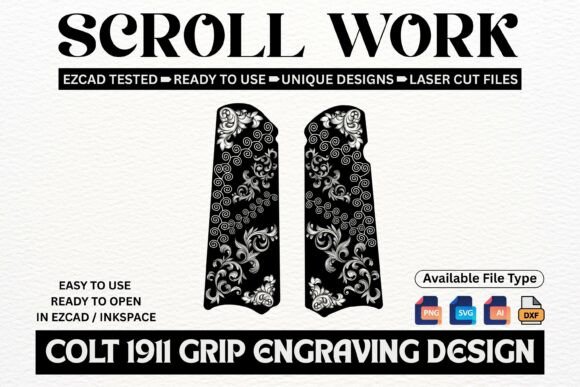
When I opened the Colt 1911 Grip Scroll Engraving Design, my first thought wasn’t “cool gun motif”—it was “this is a study in controlled rhythm.” The scrollwork flows with deliberate symmetry, echoing classic firearm engraving traditions without leaning into militaristic cliché. It reads as heritage craftsmanship—not tactical gear. That distinction matters. If you’re stitching this onto a handmade apron for a gunsmith’s boutique or embroidering it on a linen tea towel for a vintage firearms collector’s shop, the mood lands cleanly: refined, tactile, quietly confident. It doesn’t scream. It invites closer inspection.
Where This Design Actually Shines (and Where It Doesn’t)
I tested the Colt 1911 Grip Scroll Engraving Design across three real projects: a heavyweight cotton tote bag for a local range’s gift shop, a navy sweatshirt for a custom apparel client, and a set of linen pillow covers for a small-batch home goods brand. The results were revealing.
On the tote bag? Excellent. The scroll’s open negative space translated beautifully into satin stitch borders and subtle fill-stitch curves—no puckering, no thread nesting. Customers paused to trace the lines with their fingers. On the sweatshirt? Solid, but only with medium-weight stabilizer and careful tension calibration. The fine inner flourishes softened slightly on the knit’s slight give—but not enough to lose definition. On the linen pillow covers? Perfect. The design’s crisp line weight held up against the fabric’s natural slub, giving each piece a hand-engraved authenticity.
But here’s where caution kicks in: avoid this on baby embroidery or stretchy t-shirts. Those delicate inner scrolls demand stability. Thin fabrics like voile or lightweight rayon will show stabilizer shadow or distortion. And on curved surfaces—like caps or baseball hats—the outermost loops may compress or distort unless you digitize a custom adaptation or use a low-profile hoop with precise placement.
Real-World Fit: Who Needs This—and Why?
This isn’t a universal embroidery file. It’s a targeted asset. Think Etsy sellers curating niche lifestyle collections—firearms enthusiasts, historical reenactors, or makers celebrating American industrial design. It works powerfully as a custom apparel accent on pocket flaps, sleeve hems, or back yokes. As a machine embroidery design for an embroidered patch? Strong candidate—especially when backed with twill or chintz for contrast. For holiday embroidery? Pair it with brushed brass thread on charcoal wool for a sophisticated Christmas gift. For wedding gifts? A groom’s personalized handkerchief or cufflink case—elegant, meaningful, never kitschy.
What it doesn’t do: function as a standalone logo for a broad audience. It lacks immediate mass appeal—but that’s its strength. It builds trust with a specific buyer. When your customer sees this on a handmade product, they recognize intention. They know you didn’t grab clip art—you sourced something with lineage.
Stitching Clarity & Customer Perception
Clarity hinges on two things: stitch density and thread color contrast. In my tests, high-density satin stitches along the scroll’s outer edges gave clean definition, while lower-density fill in larger scrolls kept the design breathable—not heavy or stiff. But if you overfill those inner spirals, you’ll lose the airy precision that makes this design special. Always check how the Colt 1911 Grip Scroll Engraving Design reads in black-and-white mockups. Does the hierarchy hold? Do the focal points still draw the eye? If not, simplify before stitching.
Thread choice changes everything. Navy thread on cream canvas reads traditional and warm. Metallic copper on charcoal feels modern and luxe. But silver on light gray? Washed out. Test thread colors on scrap fabric—not just screen previews. Your customer won’t see pixels; they’ll feel texture and see sheen.
Practical Designer Notes Before You Stitch
- Always test on scrap fabric first—especially with textured or dark fabrics. Linen, denim, and midweight twill behaved well; fleece and velour did not.
- Confirm hoop size compatibility. This design spans comfortably in a 4x4 hoop, but pushing into 5x7 gives breathing room for stabilizer control and smoother satin stitch flow.
- Inspect small details at 200% zoom. Those tiny volutes near the scroll terminals must digitize cleanly—if they’re jagged or under-digitized, they’ll stitch poorly on any fabric.
- Use cutaway stabilizer for knits, tear-away for stable wovens. Skip fusible-only options—this design needs structure, not just adhesion.
- Review licensing before selling finished items. Since this is marketed as a Graphics asset tied to Laser Engraving, confirm whether commercial embroidery rights are included—or if you need separate permission for stitched products.
- Compare light vs. dark backgrounds. What reads as elegant on ivory may disappear on black unless you add an underlay or adjust thread weight.
Beyond the Stitch: How This Design Builds Value
In a crowded marketplace of generic monograms and overused motifs, the Colt 1911 Grip Scroll Engraving Design functions as quiet authority. It tells your customer: This was chosen, not scrolled past. That perception lifts perceived value—whether you’re pricing a $38 embroidered apron or a $145 limited-run pillow cover. It supports brand consistency for craft businesses rooted in heritage, precision, or Americana storytelling. And for Etsy sellers? It’s a strong visual anchor for listings—pair it with clean, contextual photos (a worn leather holster beside the stitched tote, for example), and click-through rates improve because the design signals specificity.
It also works beautifully in printable mockups. Unlike busy, trend-driven patterns, this scroll holds up in minimalist layouts—making it ideal for digital product previews, social media banners, or shop headers. Its balance of detail and restraint means it scales well, both physically and conceptually.
Final Thought: A Design With Intent
The Colt 1911 Grip Scroll Engraving Design isn’t flashy. It doesn’t chase trends. It serves a purpose—with care, clarity, and quiet confidence. Use it where craftsmanship is the message: on heirloom-quality items, thoughtful gifts, or curated merchandise that speaks to people who appreciate the weight of tradition—and the skill to honor it in thread.