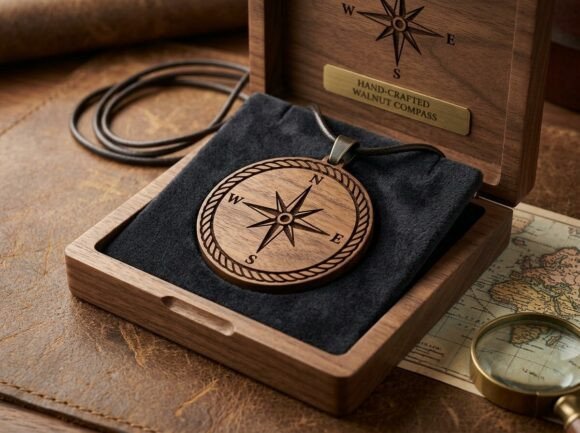
Compass Rose Pendant Laser Cut Design: Graphics for Crafts
As a digital product creator who’s launched over 200 design assets across Etsy, Creative Market, and Shopify—many of them laser-cut jewelry templates—I opened Compass Rose Pendant Laser Cut Design expecting precision, versatility, and quiet elegance. What I found was a clean, balanced compass star motif: symmetrical but not stiff, detailed but not fussy, with clear directional markers and subtle ornamental flourishes. It reads as adventurous yet refined—ideal for customers drawn to travel, exploration, nautical themes, or mindful living. This isn’t a cartoonish novelty piece; it’s a commercial design that leans into sophistication without sacrificing craft-friendly simplicity.
The mood is timeless—not trendy, not dated. Think handmade jewelry brands on Etsy selling minimalist brass pendants, or print-on-demand shops curating “meaningful accessories” collections. It appeals to small business branding that values visual hierarchy and quiet confidence: think serif fonts for packaging labels, soft neutral mockups, and cohesive Canva templates for social media announcements. It doesn’t shout—it invites closer look. That makes it especially effective for premium-priced digital downloads where perceived value hinges on restraint and execution.
In real product development, Compass Rose Pendant Laser Cut Design works across multiple formats and use cases. As an SVG design, it cuts cleanly on Cricut Maker and Silhouette Cameo—tested at 1.5" and 2.5" sizes with no jagged edges or stray nodes. The DXF and EPS files imported smoothly into LightBurn and CorelDRAW for industrial laser prep. As a PNG design (300 DPI, transparent background), it scaled beautifully for sublimation mugs, tumbler wraps, and tote bag prints—no pixelation even when enlarged to 6". As clipart, it fits naturally in printable planner stickers and greeting card sets, especially when paired with handwritten fonts or light watercolor textures. And because the lines are consistent and well-spaced, it holds up in digital paper packs and scrapbooking kits without overwhelming layouts.
Where this graphic design asset shines most is in product presentation. Used in a product mockup—say, a brushed gold pendant on a linen ribbon against a sage backdrop—it immediately signals intentionality and craftsmanship. As a thumbnail for an Etsy product listing, its strong central shape and clear negative space give it high click-through potential, even among crowded search results. Bundled with coordinating anchor icons or vintage map elements, it anchors themed collections like “Adventure Journal Kits” or “Nautical Wedding Printables.” For Canva template sellers, it slots neatly into invitation suites or social media graphics without needing heavy editing—just adjust color mode to match brand palettes (I tested it in navy, terracotta, charcoal, and cream with excellent contrast).
This design performs best in larger-scale applications: 3"+ wall art prints, 4"+ t-shirt designs centered on crewnecks, or layered SVG projects for wooden keychains and acrylic charms. It also strengthens brand identity when repeated subtly—on packaging tape, thank-you cards, or digital download cover pages—as part of a cohesive visual language. In seasonal bundles, it pairs well with autumnal palettes (burnt sienna + olive) or spring palettes (sky blue + sand), making it flexible beyond just “travel” niches.
That said, use caution in contexts demanding extreme fine detail. At under 0.75", some inner line work begins to blur—so avoid using it raw for tiny sticker sheets unless you manually simplify paths first. On dark backgrounds, test contrast: while the outline remains legible, thin interior lines can recede unless you add a subtle stroke or shadow layer. Avoid cramming it into text-heavy templates—its strength is visual breathing room, not dense decoration. And if you’re prepping for Cricut or Silhouette projects, always inspect the SVG cut quality: confirm all strokes are set to 0.001pt or “cut” mode, and that compound paths are flattened where needed. One quick test cut on scrap material saves hours of troubleshooting later.
Before publishing any finished product, run these practical checks: preview the design as a 120x120px marketplace thumbnail (does the core shape read instantly?); test it on both white and charcoal mockups; verify PNG transparency by placing it over a gradient; check how sublimation colors render across light/dark fabrics; and confirm your commercial license permits finished goods—especially for print-on-demand platforms that restrict certain motifs. Organize delivered files clearly: label SVG/DXF/EPS/PDF versions distinctly, include a README with recommended sizing and font pairings (I found it works beautifully with Playfair Display for headings, Lato for body, and Pacifico for accent text), and offer a bonus color guide PDF showing hex values for five versatile palettes.
Ultimately, Compass Rose Pendant Laser Cut Design isn’t just another clipart file—it’s a foundational design asset. It supports handmade business growth by enabling consistent, scalable visuals across digital downloads, physical merchandise, and brand storytelling. Whether you’re building a niche Etsy shop around meaningful accessories, launching a Canva template store focused on travel creatives, or expanding your sublimation catalog for outdoor lifestyle brands, this graphic design asset delivers quiet professionalism. It’s the kind of commercial design that doesn’t distract—it deepens trust, elevates perceived value, and quietly tells your customer: *this was made with care.*