Butterfly Book Stack
A Designer’s First Look: Whimsy with Quiet Confidence
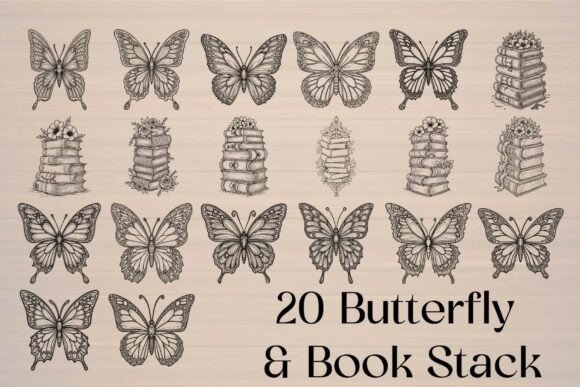
Opening the Butterfly Book Stack bundle, I didn’t just see 20 designs—I felt a distinct mood shift. There’s an immediate elegance in the way the butterflies rest atop those stacked vintage books, wings slightly asymmetrical, antennae delicate but legible. The floral accents aren’t fussy; they’re supportive, like quiet punctuation. This isn’t maximalist embroidery—it’s thoughtful curation. As a designer who’s stitched everything from boutique baby onesies to Etsy shop banners, I knew right away this collection leans into soft storytelling: literary charm, gentle femininity, and handmade warmth. It doesn’t shout. It invites.
Real-World Test: A Linen Tote Bag for a Local Bookstore Pop-Up
Last week, I used one of the mid-sized Butterfly Book Stack designs (a vertical stack with a single open-wing butterfly hovering above) on a natural linen tote bag—intended for a neighborhood indie bookstore’s summer launch. No flash, no glitter, just clean stitching on textured fabric. The result? Customers paused. Not because it was loud, but because it felt *considered*. The satin stitch on the book spines held crisp definition, while the butterfly’s fill stitch remained airy—not dense or muddy—even at 3.8" tall. That balance is rare. Too many “elegant” designs collapse into stitch soup on real fabric. Butterfly Book Stack didn’t. It translated.
Where It Shines—and Where It Asks for Care
This collection excels in context-driven projects:
- Custom apparel: Works beautifully on lightweight sweatshirts and relaxed-fit tees—especially when placed off-center or along a seam. The layered composition reads well even at modest scale.
- Baby embroidery: Ideal for onesies, burp cloths, and crib mobiles. The rounded shapes and lack of sharp interior angles mean fewer thread breaks and smoother hooping on delicate fabrics.
- Embroidered patch potential: Several designs have clear outer edges and balanced negative space—making them strong candidates for iron-on or sew-on patches on denim jackets or backpacks.
- Holiday and wedding gifts: Think tea towels for bridal showers, pillow covers for nursery reveals, or aprons for book club hosts. It’s sentimental without being saccharine.
- Craft business branding: Perfect for subtle shop tags, packaging seals, or digital embroidery file previews—its visual personality supports a cohesive, artisanal brand voice.
But—and this matters—it’s not universally forgiving. On stretchy knits or ultra-thin rayon, I’d reduce density manually or add a light tear-away + cut-away stabilizer combo. Curved surfaces like caps require careful placement: avoid designs where the book stack wraps too tightly around the crown—those corners can distort. And while the butterflies read clearly on light fabric, test carefully on dark backgrounds: some fine wing veins rely on subtle thread contrast. If your black embroidery thread lacks sheen, those details soften.
What It Does for Your Finished Product—Beyond Stitching
Butterfly Book Stack quietly lifts perceived value. On a plain cotton kitchen towel, it transforms utility into heirloom energy. On a personalized gift, it signals care—not just “I embroidered this,” but “I chose something that fits *you*.” For Etsy sellers, that nuance affects conversion: buyers scroll past generic florals but linger on designs with narrative weight. And yes—it supports professionalism. When clients see consistent, well-proportioned machine embroidery design work across your portfolio, trust builds. This collection helps you deliver that, especially if your niche is literary, botanical, or gently nostalgic.
Practical Designer Notes You’ll Actually Use
Before cutting thread or uploading to your machine:
- Test on scrap fabric first—especially if using textured linen, terry cloth, or blends. Watch how the fill stitch settles into the weave.
- Check thread color contrast on both light and dark mockups. Some designs include tiny running-stitch outlines—those vanish if thread blends too closely with fabric.
- Review stitch density in your embroidery software. A few designs lean denser near book spines—adjust if embroidering on lightweight baby items.
- Confirm hoop size compatibility. Most fit comfortably in a 4x4 hoop, but two wider horizontal layouts may need 5x7. Don’t assume.
- Inspect small details at actual stitch size: antennae tips, petal edges, page curl lines. Zoom in. If they disappear in simulation, they’ll vanish on fabric.
- Use proper stabilizer: medium-weight cut-away for stable wovens, lightweight tear-away for delicate items. Skip the “stabilizer lite” gamble here—the floral accents need support.
- Verify licensing before selling finished products or digital embroidery files. Since Butterfly Book Stack is marketed as Graphics within Crafts, confirm whether commercial use is included—or if separate permissions apply.
Final Thought: A Design That Serves the Maker, Not Just the Machine
Many embroidery files impress in preview mode but falter under needle pressure. Butterfly Book Stack avoids that trap. Its strength lies in restraint: smart spacing, intentional detail hierarchy, and shapes built for real-world fabric behavior. It won’t overwhelm a baby onesie. It won’t bore on a boutique apron. And it gives small shop owners and creative entrepreneurs a versatile, emotionally resonant asset—one that feels handmade, not algorithmically generated. Whether you're stitching a custom embroidered patch for a craft fair booth or prepping printable mockups for your next Etsy listing, this collection earns its place in your active design folder—not just your archive.